
Key Questions for Touring Senior Living Communities Uncovering the Basics
Comparative Insights What to Look for in Senior Living Communities
Evaluating Amenities and Services in Senior Living Communities Essential Queries
I'm touring senior living communities, but they all look good and I don't know which questions will uncover the important differences
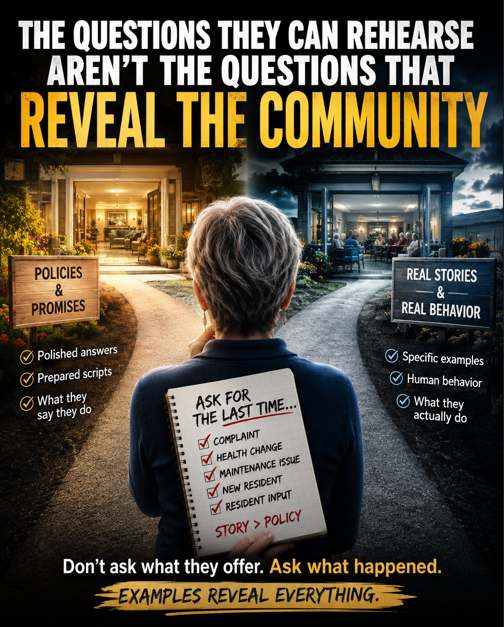
Don’t judge a senior living community by whether problems exist. Judge it by what happens after a problem becomes visible.
Senior Living Answers with Fred Van Ryn — A Neighbor You Can Trust
Choosing where and how to live as we grow older can raise a lot of questions.
Senior Living Answers with Fred Van Ryn LLC was created to help seniors and their families find clear, practical answers about senior living—from understanding costs and services to comparing communities and knowing what questions to ask.
Fred approaches senior living from a personal, down-to-earth perspective. The goal isn't to tell you what decision to make. It's to help you become better informed so you can decide what's right for you and your family.
Real questions. Straight answers. Better-informed decisions.
The Questions They Can Rehearse Aren’t the Questions That Reveal the Community
When you tour a senior living community, it’s surprisingly easy to leave impressed and still know very little about what it would actually be like to live there.
The apartment may be attractive. The dining room may look inviting. The activity calendar may be full. The staff member conducting the tour may be warm, knowledgeable, and ready with answers to every question you ask.
None of that is necessarily misleading.
The problem is that most prospective residents ask almost the same questions.
“What activities do you offer?”
“What are the meals like?”
“Is transportation available?”
“How often is housekeeping provided?”
“What happens if I need more help later?”
Those are reasonable questions. You should ask them.
But they’re also questions a community answers every week.
The answers have usually been explained, refined, and repeated many times. The person giving the tour knows exactly how to describe the dining program, activities, transportation, housekeeping, security, and other features.
So the important distinction isn’t between good questions and bad questions.
It’s between information questions and evidence questions.
An information question asks what the community says it does.
An evidence question asks for a real example of what the community did when something actually happened.
That distinction can completely change the value of your tour.
A polished description tells you about the system as it’s supposed to work.
A specific example gives you a glimpse of the system under pressure.
And senior living decisions are often made or regretted based on what happens when life doesn’t go according to the brochure.
Ask for the story, not just the policy
Imagine asking two communities the same question:
“What happens when a resident has a complaint?”
Community A answers:
“We take resident concerns very seriously. Residents can speak with any member of our management team, and we work hard to resolve concerns quickly and respectfully.”
That sounds good.
It may also be completely true.
But what did you actually learn?
Mostly, you learned how the community describes its complaint process.
Now change the question:
“Can you tell me about the last time a resident had a serious complaint and what happened?”
That question is harder to answer with a prepared statement.
The person giving the tour now has to retrieve an event.
Maybe the answer is:
“A resident recently complained that dinner service had become too slow. Several residents were frustrated. Our dining manager met with them, changed the seating process, and added another server during the busiest period. We checked back with the residents afterward.”
That answer gives you information the first answer didn’t.
You now know that complaints happen.
You know residents felt comfortable enough to complain.
You know management listened.
You know the response involved a concrete operational change.
And perhaps most importantly, you have something you can ask a follow-up question about.
“How long did it take from the complaint until the change was made?”
That follow-up may tell you more than another ten minutes of touring.
This is the reusable thinking device to carry with you:
When an answer sounds polished, ask for the last real example.
Not because you’re trying to trap anyone.
Because examples reveal behavior.
Policies reveal intentions.
In an important decision, you want both.
This works with far more than complaints.
Instead of:
“What happens if a resident gets sick?”
Ask:
“Can you give me an example of what happened recently when an independent-living resident became ill and needed extra help for a while?”
Instead of:
“Do residents have input?”
Ask:
“What’s something residents asked management to change recently, and what happened?”
Instead of:
“How do you welcome new residents?”
Ask:
“Tell me about someone who moved in recently. What did you do during their first couple of weeks to help them get connected?”
Instead of:
“How responsive is maintenance?”
Ask:
“What’s a recent maintenance problem that affected a resident, and how was it handled?”
The shift is subtle but powerful.
You’re moving from claims to cases.
Why specific examples reveal so much
A real-life example forces several hidden parts of the community to become visible at once.
First, it reveals what the community notices.
If you ask about a struggling new resident and the person immediately remembers a situation, that can tell you they pay attention to how newcomers adjust.
Second, it reveals who takes responsibility.
Listen for names, roles, or departments.
Did someone own the problem, or did it bounce around?
Third, it reveals speed.
Many organizations have procedures. Fewer can clearly explain what happens between the moment a problem appears and the moment someone acts on it.
Fourth, it reveals follow-through.
Did staff simply respond, or did they later check whether the response actually solved the problem?
And fifth, examples reveal something more difficult to put on a brochure: the community’s instincts.
When something goes wrong, does the organization become defensive?
Does it explain why nothing can be done?
Does it involve the resident?
Does it look for a practical solution?
Does it follow up afterward?
You’re not looking for a community where nothing ever goes wrong. That standard would be unrealistic.
You’re trying to discover how the community behaves when something does go wrong.
That’s a much more useful test.
Here’s a rule worth remembering:
Don’t judge a senior living community by whether problems exist. Judge it by what happens after a problem becomes visible.
That’s the part of community life you may eventually depend on.
Consider a realistic example.
Suppose you’re touring Community A and Community B.
Both are attractive.
Both have friendly staff.
Both have similar apartments.
Both offer transportation, activities, dining, and maintenance.
You ask Community A:
“What happens if a resident starts becoming isolated?”
The response is:
“Our activities department works very hard to keep everyone engaged. We have a wonderful calendar with something for everybody.”
Again, it’s not a bad answer.
But you don’t yet know what happens to the resident who doesn’t attend.
So you ask:
“Can you give me an example of a resident who wasn’t participating much and what you did?”
There’s a pause.
The answer stays general.
“We encourage residents to participate, but of course everyone makes their own choices.”
Now ask the same question at Community B.
The staff member says:
“We had a gentleman move in a few months ago who kept mostly to himself. One of our staff noticed he used to be involved with woodworking, so we introduced him to two residents who were working on a small shop project. He didn’t become involved in everything, but he started meeting them regularly.”
You still shouldn’t assume Community B is automatically better.
One story doesn’t prove everything.
But now you have evidence of a behavior worth investigating.
Someone noticed.
Someone remembered an interest.
Someone made an introduction.
The solution wasn’t simply “more activities.”
It was connection.
That’s the difference evidence questions can expose.
They also help you distinguish between features and operating culture.
A feature is something the community has.
An operating culture is how people behave.
Two communities can have nearly identical features and feel very different six months after you move in because their operating cultures are different.
The tour brochure can show you the fitness room.
An example may reveal whether anyone notices when a resident stops showing up.
The menu can show you what’s served.
An example may reveal how staff respond when residents repeatedly dislike something.
The maintenance policy can tell you how to request repairs.
An example may reveal whether a broken air conditioner on a hot afternoon is treated as a ticket in a queue or as a resident problem requiring immediate attention.
That’s what you’re really trying to uncover.
Not whether the community has systems.
Whether the systems turn into dependable human behavior.
Use the “last time” test
You don’t need to turn your tour into an interrogation.
Pick several areas that matter most to you and use what I call the last time test.
Ask:
“What happened the last time...?”
“What’s a recent example of...?”
“Can you tell me about someone who...?”
“What did you do when...?”
“What changed after...?”
These questions work because they move the conversation out of the abstract.
Pay attention to the structure of the answer, not just whether it sounds positive.
A useful real-world answer often contains four things:
The situation. Something happened.
The response. Someone did something.
The result. Something changed, improved, remained unresolved, or required another step.
The follow-up. Someone checked what happened afterward.
You can mentally listen for those four pieces.
For example:
“A resident complained about noise from an apartment above her.”
That’s the situation.
“Our manager spoke with both residents and looked into what was causing it.”
That’s the response.
“They discovered part of the noise was coming from a loose piece of flooring and repaired it.”
That’s the result.
“We checked back with her later that week to make sure the problem had improved.”
That’s the follow-up.
A story that naturally includes those pieces tells you far more than “We take noise complaints seriously.”
Also notice when examples are strangely difficult to produce.
That doesn’t automatically mean something is wrong. A staff member may simply not remember a suitable example, may want to protect resident privacy, or may not personally handle that area.
So don’t treat hesitation as proof.
Instead, give them another route.
“I understand you can’t discuss private details. Even without names, can you describe generally how a situation like that was handled?”
If the answer still stays entirely in policy language, make a mental note.
You may want to ask another staff member later.
You can also use this method with residents.
Instead of asking a resident:
“Do you like living here?”
Ask:
“When you’ve needed help with something, how has that gone?”
Or:
“Has anything changed here because residents spoke up about it?”
Those questions invite experience rather than a rating.
Someone can honestly say, “Yes, I like it here,” and still have useful observations about communication, maintenance, dining, transportation, or management.
The deeper point is that a senior living tour shouldn’t only answer the question:
What does this community offer?
It should help you answer:
How does this community behave?
That second question is harder to put on a comparison sheet, but it may matter more once you live there.
Before your next tour, take the three or four issues that would matter most to your day-to-day life and turn each one into an evidence question.
If responsiveness matters, don’t just ask whether staff are responsive.
Ask what happened the last time a resident needed something handled quickly.
If resident voice matters, don’t just ask whether residents have input.
Ask for something that changed because residents spoke up.
If adapting to health changes matters, don’t just ask what services exist.
Ask them to walk you through a recent situation in which someone’s needs changed.
And if you remember only one rule, make it this one:
Whenever you hear an answer describing what they usually do, ask what happened the last time they actually had to do it.
That’s often where the differences between communities finally stop looking alike.